
The AI Control Layer for Human Work
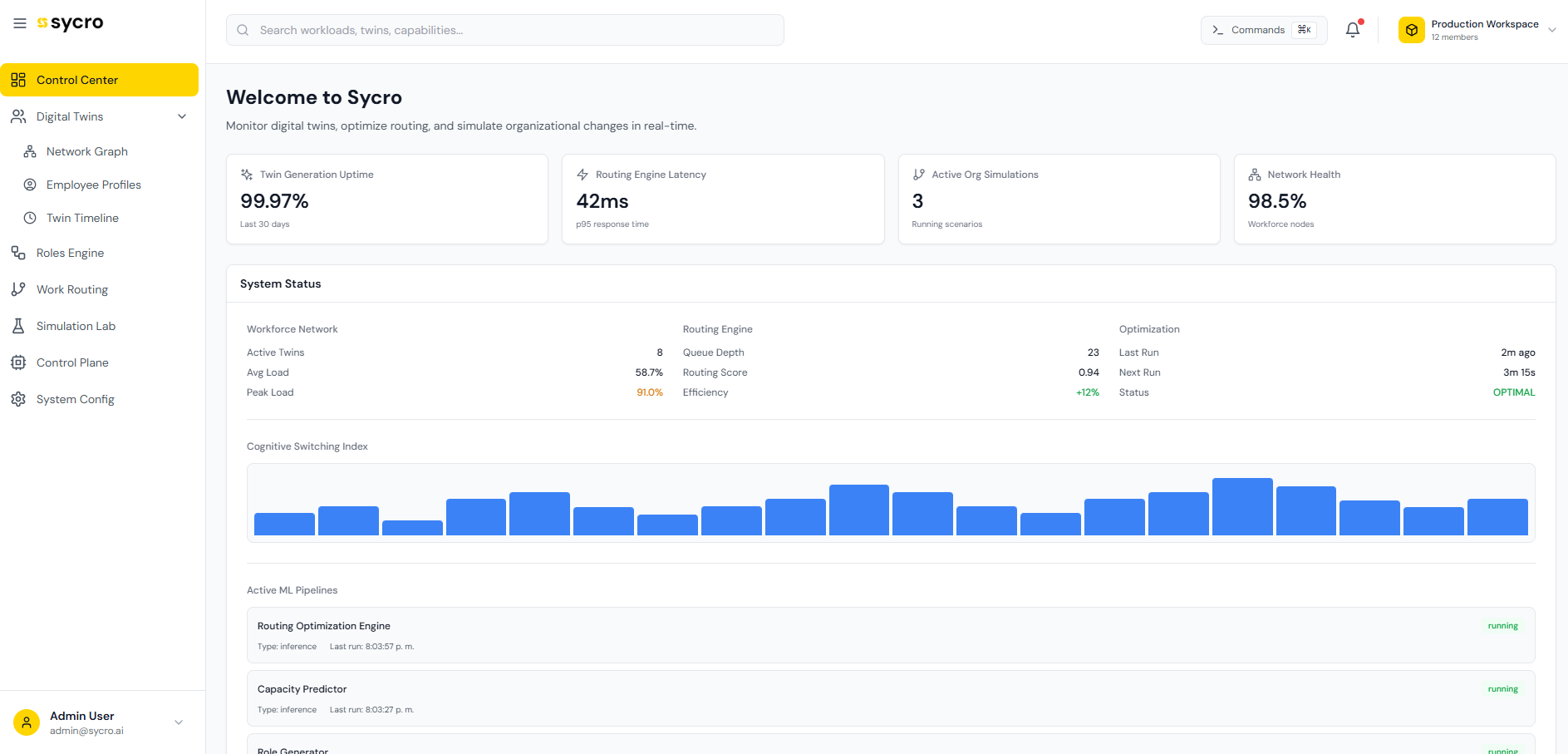
Sycro autonomously orchestrates work across your teams and tools - detecting what needs to happen, routing it, following up, unblocking people, and completing workflows end-to-end. No more chasing. No more chaos.



Join +
others on the waitlist
Join +
others on the waitlist
days
hours
minutes
seconds
days
hours
minutes
seconds



Frequently asked questions
Everything you need to know about Sycro. Find answers to the most common questions below.
What is Sycro?
Sycro is an AI operating system that autonomously orchestrates human work. It uses digital twins, dynamic roles, and predictive workforce routing to help companies self-organize, operate faster, and eliminate manual coordination.
How does Sycro work inside my organization?
Sycro creates a digital twin of your team, workflows, skills, and demand patterns. Then, its orchestration engine predicts work needs, assigns roles dynamically, routes tasks to the right people, and adapts in real time as conditions change.
How is Sycro different from Zapier, Make, Workato, etc.?
Zapier automates steps. Sycro orchestrates work. Zapier/Make require humans to build flows, define rules, maintain logic, and specify every trigger and action. Sycro does the opposite: It reads real work happening across your tools It understands context, roles, and dependencies It decides what needs to happen next It coordinates humans It executes end-to-end workflows It adapts when things change It closes work without predefined flows
What makes Sycro different from project management or HR software?
Project management tools help track work, Sycro performs the orchestration. HR tools store data, Sycro uses that data to make decisions. We’re not a dashboard. We’re the control layer that makes your company adaptive, intelligent, and self-organizing.
Does Sycro replace employees?
No. Sycro doesn’t replace people, it removes coordination overhead. Your teams stay in control, while Sycro handles the routing, delegation, prioritization, and cross-functional synchronization that normally slows companies down.
Who is Sycro for?
Sycro is designed for fast-scaling companies, operationally heavy teams, and organizations that rely on multi-step, cross-functional workflows. If your team spends too much time coordinating instead of executing, Sycro is for you.
What Sycro actually does?
Sycro reads work happening across your systems in real time - Jira, Asana, Slack, email, tickets, approvals - then predicts what needs to happen next and executes it: Detects when work is stuck Assigns or reassigns tasks automatically Follows up with humans when needed Validates completion Ensures sequencing across teams Reroutes around blockers Closes workflows end-to-end It’s not automation. It’s not a workflow builder. It’s an autonomous operations layer.
How does Sycro handle privacy and security?
Sycro is built with enterprise-grade security, encrypted by default, and compliant with global standards. Your organizational data remains private and is used exclusively to power your internal orchestration engine.
What problems does Sycro solve?
Sycro eliminates: Manual task assignment Cross-team bottlenecks Overloaded managers Misaligned priorities Inefficient workflows Time lost in meetings and status updates It gives your organization a real-time “brain” that ensures the right work happens at the right time.
How long does it take to get started?
Setup is fast. Once we integrate your org data and workflows, Sycro begins learning your patterns immediately. Most companies see value within the first 14 days as the system starts reducing manual coordination work.
What is Sycro?
Sycro is an AI operating system that autonomously orchestrates human work. It uses digital twins, dynamic roles, and predictive workforce routing to help companies self-organize, operate faster, and eliminate manual coordination.
How does Sycro work inside my organization?
Sycro creates a digital twin of your team, workflows, skills, and demand patterns. Then, its orchestration engine predicts work needs, assigns roles dynamically, routes tasks to the right people, and adapts in real time as conditions change.
How is Sycro different from Zapier, Make, Workato, etc.?
Zapier automates steps. Sycro orchestrates work. Zapier/Make require humans to build flows, define rules, maintain logic, and specify every trigger and action. Sycro does the opposite: It reads real work happening across your tools It understands context, roles, and dependencies It decides what needs to happen next It coordinates humans It executes end-to-end workflows It adapts when things change It closes work without predefined flows
What makes Sycro different from project management or HR software?
Project management tools help track work, Sycro performs the orchestration. HR tools store data, Sycro uses that data to make decisions. We’re not a dashboard. We’re the control layer that makes your company adaptive, intelligent, and self-organizing.
Does Sycro replace employees?
No. Sycro doesn’t replace people, it removes coordination overhead. Your teams stay in control, while Sycro handles the routing, delegation, prioritization, and cross-functional synchronization that normally slows companies down.
Who is Sycro for?
Sycro is designed for fast-scaling companies, operationally heavy teams, and organizations that rely on multi-step, cross-functional workflows. If your team spends too much time coordinating instead of executing, Sycro is for you.
What Sycro actually does?
Sycro reads work happening across your systems in real time - Jira, Asana, Slack, email, tickets, approvals - then predicts what needs to happen next and executes it: Detects when work is stuck Assigns or reassigns tasks automatically Follows up with humans when needed Validates completion Ensures sequencing across teams Reroutes around blockers Closes workflows end-to-end It’s not automation. It’s not a workflow builder. It’s an autonomous operations layer.
How does Sycro handle privacy and security?
Sycro is built with enterprise-grade security, encrypted by default, and compliant with global standards. Your organizational data remains private and is used exclusively to power your internal orchestration engine.
What problems does Sycro solve?
Sycro eliminates: Manual task assignment Cross-team bottlenecks Overloaded managers Misaligned priorities Inefficient workflows Time lost in meetings and status updates It gives your organization a real-time “brain” that ensures the right work happens at the right time.
How long does it take to get started?
Setup is fast. Once we integrate your org data and workflows, Sycro begins learning your patterns immediately. Most companies see value within the first 14 days as the system starts reducing manual coordination work.
What is Sycro?
Sycro is an AI operating system that autonomously orchestrates human work. It uses digital twins, dynamic roles, and predictive workforce routing to help companies self-organize, operate faster, and eliminate manual coordination.
How does Sycro work inside my organization?
Sycro creates a digital twin of your team, workflows, skills, and demand patterns. Then, its orchestration engine predicts work needs, assigns roles dynamically, routes tasks to the right people, and adapts in real time as conditions change.
How is Sycro different from Zapier, Make, Workato, etc.?
Zapier automates steps. Sycro orchestrates work. Zapier/Make require humans to build flows, define rules, maintain logic, and specify every trigger and action. Sycro does the opposite: It reads real work happening across your tools It understands context, roles, and dependencies It decides what needs to happen next It coordinates humans It executes end-to-end workflows It adapts when things change It closes work without predefined flows
What makes Sycro different from project management or HR software?
Project management tools help track work, Sycro performs the orchestration. HR tools store data, Sycro uses that data to make decisions. We’re not a dashboard. We’re the control layer that makes your company adaptive, intelligent, and self-organizing.
Does Sycro replace employees?
No. Sycro doesn’t replace people, it removes coordination overhead. Your teams stay in control, while Sycro handles the routing, delegation, prioritization, and cross-functional synchronization that normally slows companies down.
Who is Sycro for?
Sycro is designed for fast-scaling companies, operationally heavy teams, and organizations that rely on multi-step, cross-functional workflows. If your team spends too much time coordinating instead of executing, Sycro is for you.
What Sycro actually does?
Sycro reads work happening across your systems in real time - Jira, Asana, Slack, email, tickets, approvals - then predicts what needs to happen next and executes it: Detects when work is stuck Assigns or reassigns tasks automatically Follows up with humans when needed Validates completion Ensures sequencing across teams Reroutes around blockers Closes workflows end-to-end It’s not automation. It’s not a workflow builder. It’s an autonomous operations layer.
How does Sycro handle privacy and security?
Sycro is built with enterprise-grade security, encrypted by default, and compliant with global standards. Your organizational data remains private and is used exclusively to power your internal orchestration engine.
What problems does Sycro solve?
Sycro eliminates: Manual task assignment Cross-team bottlenecks Overloaded managers Misaligned priorities Inefficient workflows Time lost in meetings and status updates It gives your organization a real-time “brain” that ensures the right work happens at the right time.
How long does it take to get started?
Setup is fast. Once we integrate your org data and workflows, Sycro begins learning your patterns immediately. Most companies see value within the first 14 days as the system starts reducing manual coordination work.